
SEO used to mean spreadsheets, guesswork, and hours spent digging through search results by hand. That world is gone. In 2026, the tools doing the heavy lifting are built on AI, and they are changing how content gets researched, written, and ranked.
Manual SEO still works, but it is slow. A single keyword research session, a competitor content audit, and an on-page optimization pass can eat an entire day. AI SEO tools compress that same work into minutes. They read hundreds of ranking pages at once, spot patterns a human would miss, and hand you a content brief before your coffee gets cold.
There is also a bigger shift happening. Google is no longer the only place people search. AI Overviews sit at the top of search results, and millions of people now ask ChatGPT, Gemini, and Perplexity their questions directly instead of typing them into a search box. This is why Generative Engine Optimization, or GEO, has become just as important as traditional SEO. Ranking well on Google is no longer enough. Your content also needs to show up when an AI model is deciding which sources to cite.
This guide walks through what AI SEO tools actually do, why they matter this year, and a detailed look at the top 10 platforms worth considering. You will also find a comparison table, guidance on choosing the right tool for your budget and business type, common mistakes to avoid, and answers to the questions people ask most often about AI and SEO.
What Are AI SEO Tools?
AI SEO tools are software platforms that use machine learning and natural language processing (NLP) to automate and improve search engine optimization tasks. Instead of manually checking keyword density or guessing what a search engine wants, these tools analyze real search intent, real ranking pages, and real user behavior, then turn that data into clear recommendations.
They typically help with keyword research, content optimization, competitor analysis, technical SEO audits, content briefs, and increasingly, tracking how a brand appears inside AI-generated answers.
Also Read : Best Social Media Marketing Agency Near Vijay Nagar Square Indore (2026)
How AI SEO Tools Work
Most AI SEO tools follow a similar process. First, they scan the top-ranking pages for a given keyword using SERP analysis. Then they use NLP models to identify the entities, topics, and semantic keywords that those pages have in common. From there, the tool builds a content brief or a scoring system that tells you what to include, how long your content should be, and which questions your article needs to answer to match search intent.
Some tools stop there and hand the brief to a human writer. Others, like Jasper or Surfer AI, go a step further and generate a full draft using large language models trained on SEO best practices. The more advanced platforms also run technical SEO checks, monitor Core Web Vitals, and now track citations across AI search engines like ChatGPT and Google AI Mode.
Benefits of AI in SEO
The biggest benefit is speed. A content brief that used to take two hours of manual research can be generated in under five minutes. AI tools also reduce guesswork by grounding recommendations in actual ranking data instead of opinion.
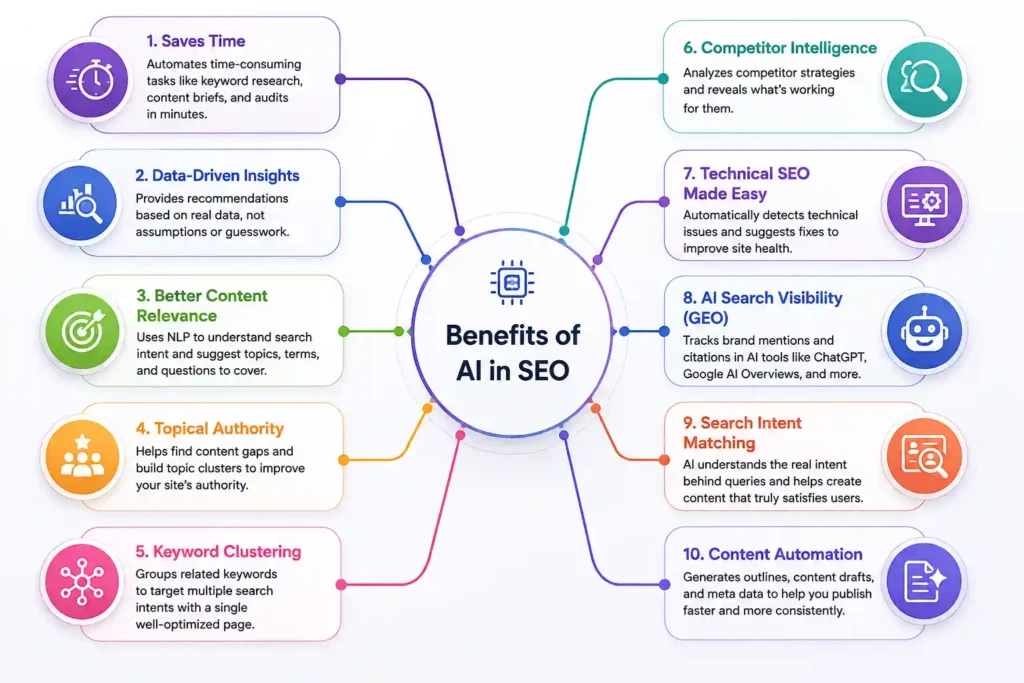
They help with topical authority by revealing content gaps and suggesting topic clusters, which makes internal linking and site structure planning much easier. AI-powered keyword clustering groups similar search intents together so you are not writing five separate articles that compete with each other. And for teams tracking AI Overviews and AI search visibility, these platforms now show whether your brand is being mentioned by ChatGPT or Gemini for relevant queries, something that was impossible to measure just two years ago.
Also Read : Local SEO for Small Businesses in Indore | How to Rank on Google in 2026
Why AI SEO Tools Matter in 2026
A few shifts happened over the past year that make AI SEO tools more important than ever.
AI Overviews now appear above traditional search results for a large share of queries, which means fewer people click through to websites for simple questions. To stay visible, content needs to be structured in a way that AI systems can easily extract and cite, which is exactly what modern content optimization tools are built to check.
Content optimization has also matured. It is no longer about stuffing a keyword ten times. Today’s tools score content based on semantic relevance, entity coverage, and how well an article satisfies the full range of related questions people ask.
Keyword clustering has become a core feature rather than an afterthought. Instead of targeting one keyword per page, tools now group dozens of related long tail keywords into a single topic cluster, helping you build genuine topical authority instead of a scattered collection of thin pages.
GEO, or Generative Engine Optimization, is the newest addition to the SEO toolkit. It focuses specifically on how content gets cited inside AI-generated answers, and most major platforms including Semrush, Ahrefs, Surfer, and Frase have added dedicated AI visibility tracking in the past year.
Search intent matching has improved dramatically because AI models can now interpret the actual meaning behind a query rather than just matching keywords. And content automation, from AI-generated outlines to full first drafts, has made it realistic for small teams to publish consistently without hiring a large content department.
Top 10 AI SEO Tools to Boost Google Rankings
Industry reviews and user ratings consistently point to the same group of platforms as the leaders in this space. Below is a detailed breakdown of each one, covering what it does well, where it falls short, what it costs, and who it is genuinely built for.
1. Semrush AI
Overview: Semrush is one of the most complete SEO platforms on the market, and its AI Visibility Toolkit has turned it into a serious option for brands that want to track both Google rankings and AI search mentions in one place. It combines keyword research, backlink analysis, competitor tracking, site audits, and content tools with AI-powered features like Semrush Copilot and ContentShake AI for content generation.
Key Features: Massive keyword and backlink database, AI Visibility Toolkit that tracks brand mentions across ChatGPT, Google AI Overviews, Gemini, and Perplexity, competitor AI citation tracking, and ContentShake AI for content drafting.
Pros: Extremely broad feature set that replaces several separate subscriptions, strong historical data going back over a decade, and genuinely useful AI search visibility reporting.
Cons: Pricing rises quickly once you add the AI Visibility Toolkit or extra users, and the platform has a real learning curve for beginners.
Pricing: The core SEO toolkit starts around $140 per month, while the combined Semrush One plan (SEO plus AI Visibility) starts near $200 per month. The AI Visibility Toolkit can also be purchased separately for about $99 per month per domain.
Best For: Agencies and established businesses that want one platform covering traditional SEO, content, and AI search visibility together.
2. Ahrefs AI
Overview: Ahrefs has long been known for having one of the most accurate backlink indexes in the industry, and it has spent the last year layering AI features on top of that foundation, including an AI Content Helper, AI Content Grader, and AI detection tools inside its Site Audit product.
Key Features: Deep backlink and keyword database, AI Content Helper for on-page optimization suggestions, AI-powered site audits with an “Ask AI” feature, and a low-cost Starter plan for smaller budgets.
Pros: Industry-leading backlink data, a genuinely useful technical SEO audit tool, and a new entry-level plan that makes the platform accessible to solo users.
Cons: AI content and brand visibility features are less developed than Semrush’s, and the higher tiers get expensive fast for growing teams.
Pricing: Plans range from a $29 per month Starter tier up to $1,499 per month for Enterprise, with the Lite and Standard plans (roughly $129 to $249 per month) covering most small and mid-size needs.
Best For: SEOs and content teams who prioritize backlink analysis and technical SEO alongside AI-assisted content suggestions.
3. Surfer SEO
Overview: Surfer SEO is built specifically around on-page content optimization. It analyzes over 500 on-page signals from top-ranking pages and gives writers a real-time content score inside a Google Docs–style editor, making it one of the most writer-friendly tools on this list.
Key Features: Content Editor with live scoring, SERP Analyzer, Keyword Research with clustering, a Topical Map for planning content clusters, and an AI Tracker for monitoring brand visibility in AI search.
Pros: The real-time content scoring genuinely correlates with ranking improvements, the Google Docs integration keeps writers in their normal workflow, and the Topical Map is excellent for long-term content planning.
Cons: Credits do not roll over on monthly plans, and add-ons like the AI Tracker and SERP Analyzer increase the real monthly cost beyond the advertised price.
Pricing: The Essential plan starts around $99 per month, Scale plans run from about $219 per month, and Enterprise pricing starts near $999 per month for larger teams.
Best For: Content writers and small teams publishing 10 to 20 articles a month who want hands-on, real-time optimization guidance.
4. Frase
Overview: Frase focuses on speed. It builds a full SERP-backed content brief in under two minutes, then scores your draft in real time using both an SEO score and a GEO score, making it one of the few tools that treats traditional search ranking and AI search visibility as equally important.
Key Features: AI content briefs generated from live SERP data, dual SEO and GEO scoring, AI visibility tracking across platforms like ChatGPT, Perplexity, and Claude, and site audit tools.
Pros: Very fast brief generation, transparent pricing where nearly every feature is included on every plan, and genuinely useful AI visibility tracking at a lower price than most competitors.
Cons: The optimization scoring is a bit lighter than Surfer’s, and it does not include native keyword volume or backlink data, so it works best paired with a dedicated keyword research tool.
Pricing: Plans start around $39 to $49 per month, with higher tiers scaling based on article volume rather than locking away core features.
Best For: Bloggers and lean content teams who want research, writing, and AI visibility tracking in one affordable tool.
5. ChatGPT
Overview: ChatGPT is not a dedicated SEO platform, but it has become an everyday part of most SEO workflows. Writers use it for brainstorming topic ideas, drafting outlines, rewriting sections for clarity, generating FAQ questions, and summarizing research before it goes into a specialized SEO tool for scoring.
Key Features: Natural conversation-based content drafting, quick outline and headline generation, ability to explain complex topics simply, and custom GPTs that can be built for repeatable SEO tasks.
Pros: Extremely flexible, useful at every stage of the content process, and the free plan is enough for casual use.
Cons: It has no built-in access to real-time SERP data, keyword volume, or ranking signals, so content still needs to be checked against actual search data using another tool before publishing.
Pricing: A free plan is available, with ChatGPT Plus priced at around $20 per month for faster responses and expanded features.
Best For: Anyone who wants an AI writing and brainstorming assistant to pair with a dedicated SEO optimization tool.
6. Clearscope
Overview: Clearscope is known for its clean interface and highly accurate content grading, built on natural language processing that identifies the terms and entities top-ranking content shares in common. It has expanded into what it now calls a content intelligence platform, adding AI search tracking on top of its original grading system.
Key Features: A-to-F content grading system, Topic Explorations for keyword research, Content Inventory to track which published pages need updates, and emerging Answer Engine Optimization (AEO) tracking for AI search platforms.
Pros: One of the most intuitive interfaces in this category, no per-seat pricing so teams can share one account, and grading that writers trust and understand quickly.
Cons: No technical SEO or backlink features, so it needs to be paired with another tool for full SEO coverage, and pricing is on the higher end for solo users.
Pricing: Plans start around $129 per month for Essentials, with Business around $399 per month and custom Enterprise pricing above that.
Best For: Established content and editorial teams who publish consistently and need a fast, writer-friendly grading workflow.
7. Jasper AI
Overview: Jasper is primarily a marketing-focused AI writing platform rather than a pure SEO tool, but it has become a common part of SEO workflows because of its Brand Voice training and its direct integration with Surfer SEO for on-page optimization.
Key Features: AI writing across blogs, ads, and social content, Brand Voice customization so output matches a company’s tone, a Canvas editor for long-form content, and a Surfer SEO integration for scoring content as you write.
Pros: Strong brand consistency features for teams managing multiple writers, flexible template library, and useful for scaling content production across marketing channels, not just blog posts.
Cons: SEO scoring itself depends entirely on the paid Surfer SEO integration, so the real cost of an SEO-ready setup is higher than the advertised Jasper price, and it can feel like overkill for someone who only needs blog content.
Pricing: The Creator plan starts around $39 to $49 per month and the Pro plan around $59 to $69 per month, with custom pricing for the Business tier.
Best For: Marketing teams that need consistent brand voice across many content types, with SEO as one part of a broader content operation.
8. SE Ranking AI
Overview: SE Ranking positions itself as a more affordable all-in-one alternative to Semrush and Ahrefs, bundling rank tracking, site audits, backlink monitoring, and a built-in AI Writer and Content Editor, with an AI search tracking add-on for monitoring brand visibility in tools like ChatGPT and Google AI Mode.
Key Features: Rank tracking, site audits, competitor research, a content marketing module with an AI Writer, and an AI Search add-on covering AI Overviews, AI Mode, Perplexity, and ChatGPT.
Pros: Strong feature breadth at a noticeably lower price than Semrush or Ahrefs, and white-label reporting that agencies find useful for client work.
Cons: The content marketing module and AI search tracking are locked behind higher tiers or paid add-ons, which reduces the actual cost advantage once you need the full feature set.
Pricing: The Core plan runs around $103 to $129 per month, and the Growth plan runs from roughly $223 to $279 per month, with the AI Search add-on priced separately.
Best For: Small agencies and in-house SEO teams that want a full SEO toolkit without paying premium prices for every feature.
9. NeuronWriter
Overview: NeuronWriter has built a reputation as the best value option for content optimization, delivering scoring and semantic recommendations that come close to Surfer SEO’s quality at a fraction of the price, which makes it especially popular with freelancers and small businesses.
Key Features: NLP-based content scoring, competitor SERP benchmarking, AI writing credits, and direct integrations with WordPress and Google Search Console.
Pros: Genuinely strong value for money, a usable free tier for testing the platform, and a generous money-back guarantee compared to most competitors.
Cons: Limited team collaboration and no enterprise-grade security features like SSO, and the interface has a slight learning curve compared to more polished competitors.
Pricing: Plans range from about $19 to $23 per month for the entry Bronze tier up to roughly $93 to $117 per month for the top Diamond tier, with a free tier also available.
Best For: Freelancers and small businesses that need reliable content optimization without paying premium prices.
10. MarketMuse
Overview: MarketMuse takes a different approach from most tools on this list. Instead of focusing on optimizing a single article, it analyzes your entire site’s content inventory to identify gaps, prioritize which pages to update versus rewrite, and help build topical authority at scale using patented topic modeling.
Key Features: Site Inventory analysis across your whole domain, a Personalized Difficulty score for prioritizing content, Strategy Documents for planning topic clusters, and a functional free tier for testing the platform.
Pros: Unmatched for large-scale content strategy and topic modeling depth, and genuinely useful for teams managing hundreds of existing articles.
Cons: It is built for content strategy rather than fast, single-article optimization, and pricing scales quickly for teams that need multiple users or high brief volume.
Pricing: A free tier is available with limited monthly queries, Standard plans start around $149 per month, and Premium or Business tiers run from roughly $399 up to $999 per month depending on team size.
Best For: Enterprise content teams and agencies managing large content libraries who need strategic prioritization, not just article-level scoring.
Also Read : Can You Build a Career in Digital Marketing After 12th Without a Degree?
Comparison Table
| Tool | Best For | Free Trial | Starting Price | AI Features | Rating |
|---|---|---|---|---|---|
| Semrush AI | All-in-one SEO plus AI visibility | Limited trial on some plans | ~$140/mo (AI Visibility add-on ~$99/mo) | Copilot, AI Visibility Toolkit, ContentShake AI | 4.5/5 |
| Ahrefs AI | Backlink data and technical SEO | No standalone free trial | ~$29/mo (Starter) | AI Content Helper, AI Content Grader | 4.6/5 |
| Surfer SEO | Real-time content editing | 7-day money-back guarantee | ~$99/mo | Content Editor, AI Tracker, Topical Map | 4.7/5 |
| Frase | Fast briefs plus GEO scoring | 7-day free trial | ~$39–49/mo | AI content briefs, dual SEO/GEO scoring | 4.6/5 |
| ChatGPT | Brainstorming and drafting | Free plan available | Free / ~$20/mo Plus | Conversational content generation | 4.5/5 |
| Clearscope | Content grading for teams | No free trial | ~$129/mo | Content grading, AEO tracking | 4.8/5 |
| Jasper AI | Brand voice content at scale | 7-day free trial | ~$39–59/mo | Brand Voice, Canvas editor, Surfer integration | 4.4/5 |
| SE Ranking AI | Budget all-in-one SEO suite | 14-day free trial | ~$103–129/mo | AI Writer, AI Search tracking add-on | 4.5/5 |
| NeuronWriter | Budget content optimization | Free tier available | ~$19–23/mo | NLP scoring, AI writing credits | 4.4–4.9/5 |
| MarketMuse | Site-wide content strategy | Free tier available | ~$149/mo | Topic modeling, Site Inventory | 4.6/5 |
Pricing changes fairly often in this category, so it is worth double-checking each vendor’s official pricing page before you commit to a plan.
How to Choose the Right AI SEO Tool
Choosing the right tool comes down to matching the platform to your budget, your business size, and the kind of work you actually do day to day.
Budget matters more than most people admit upfront. If you are experimenting or working with a tight budget, NeuronWriter or Frase deliver strong optimization value without a large monthly commitment. If budget is not the main constraint, Semrush or Clearscope offer more depth and polish.
Business size changes what “good enough” looks like. A solo blogger does not need the same tool as a 20-person content team, and paying for enterprise features you never touch is a common way to waste money on SEO software.
For an agency, look for white-label reporting, multiple client projects, and seat-based collaboration. Semrush, Ahrefs, and SE Ranking all handle multi-client work well.
A freelancer usually benefits most from an affordable, fast tool like NeuronWriter or Frase that covers research and optimization without a large learning curve.
A blogger publishing consistently should prioritize a writer-friendly content editor. Surfer SEO and Frase both fit this well.
An eCommerce business needs strong keyword research and technical SEO auditing more than content grading, which points toward Ahrefs or Semrush.
An enterprise team managing hundreds of existing pages benefits most from MarketMuse’s site-wide content strategy tools or Semrush’s full toolkit.
Free vs Paid AI SEO Tools
Free AI SEO tools and free tiers, like MarketMuse’s limited query allowance or NeuronWriter’s free plan, are genuinely useful for testing whether a platform fits your workflow before paying. They typically offer a handful of content analyses per month, basic keyword suggestions, and limited access to premium features like AI writing or historical data.
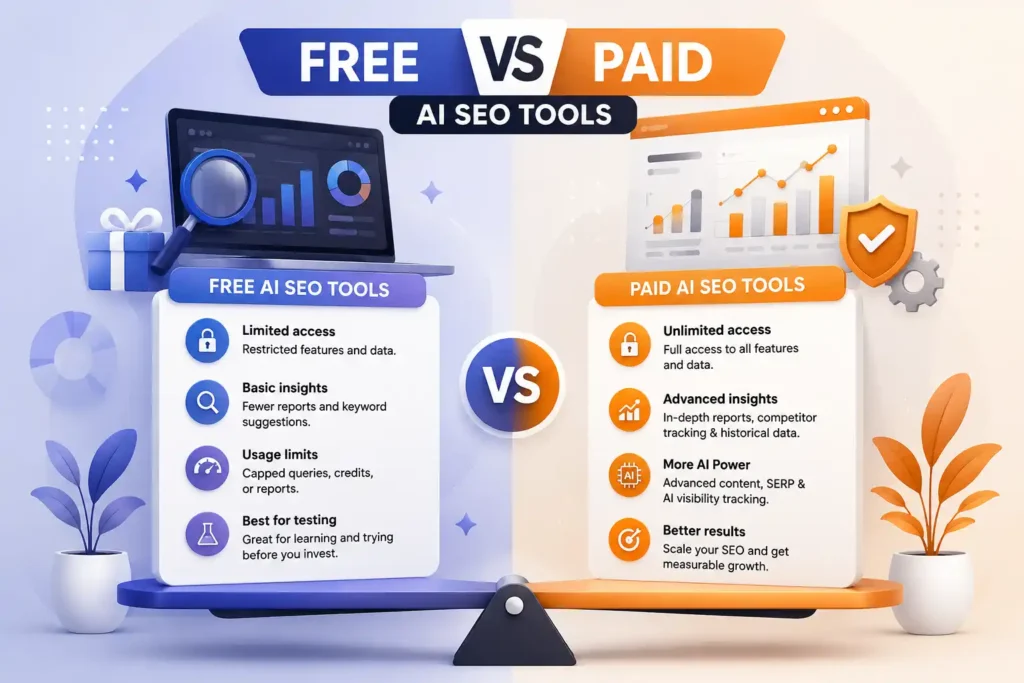
The advantage of free tools is obvious: no financial risk while you learn how the platform works. The limitation is just as obvious. Free tiers cap the number of reports, keywords, or AI credits you get each month, which makes them impractical for anyone publishing regularly or managing more than one project.
Paid plans unlock the features that actually move the needle at scale: unlimited or high-volume content briefs, historical ranking data, competitor tracking across multiple domains, and increasingly, AI search visibility tracking across ChatGPT, Gemini, and Perplexity. For a business that depends on organic traffic, a paid plan almost always pays for itself once you are publishing content consistently.
Also Read : How to Learn Digital Marketing in 3 Months | A Complete Diploma Course Guide
Can AI SEO Tools Replace Human SEO?
No. AI SEO tools are excellent at pattern recognition, data analysis, and speeding up repetitive research tasks, but they cannot replace the judgment, creativity, and lived experience that a human SEO strategist or writer brings to the table.
Strategy still requires a human decision-maker. AI can tell you what top-ranking pages have in common, but deciding which business goals to prioritize, which markets to target, and how to position a brand against competitors is a strategic call, not a data output.
EEAT, which stands for Experience, Expertise, Authoritativeness, and Trustworthiness, is fundamentally about demonstrating real human experience and credibility. An AI tool can suggest what an article should cover, but it cannot have personally used a product, interviewed an expert, or built the kind of authority that search engines and readers actually trust.
Experience is something only a person can genuinely convey. Search engines increasingly reward first-hand accounts, case studies, and original data that reflect real-world use, none of which an AI model can generate from scratch.
Creativity is another gap. AI tools are good at optimizing within a known pattern, but breaking that pattern with a genuinely original angle, a memorable headline, or a fresh way of explaining something is still a human strength.
Brand voice also needs a human touch to feel authentic over time. AI can approximate a tone, but keeping that voice consistent, nuanced, and true to a brand’s personality across hundreds of articles usually needs a human editor reviewing the output.
The realistic picture for 2026 is that AI SEO tools handle the research and optimization heavy lifting, while human strategists, writers, and editors handle judgment, originality, and trust.
Best AI SEO Tool Based on Use Case
Best for Beginners: NeuronWriter, thanks to its low price, free tier, and simple interface.
Best for Agencies: Semrush, because it combines SEO, content, PPC, and AI visibility tracking with white-label reporting in one subscription.
Best for Bloggers: Surfer SEO or Frase, both of which offer real-time content scoring inside a writer-friendly editor.
Best for Local SEO: SE Ranking, which includes strong local marketing and Google Business Profile tracking alongside its core SEO toolset.
Best for Keyword Research: Ahrefs, thanks to its large and historically deep keyword and backlink database.
Best for Technical SEO: Ahrefs, whose Site Audit tool remains one of the most detailed technical crawlers on the market.
Best for Content Writing: Jasper AI, for teams that need brand-consistent content across multiple formats, not just blog posts.
Best Budget Tool: NeuronWriter, which delivers scoring quality close to premium tools at a fraction of the cost.
Tips to Get Better Rankings Using AI SEO Tools
AI tools can speed up your workflow dramatically, but a few habits separate content that actually ranks from content that just gets published.
Never publish AI content without editing it first. AI drafts are a strong starting point, not a finished product, and unedited AI text often reads generically and can contain small factual errors that need a human check.
Add EEAT wherever possible by including real examples, original insights, quotes from credible sources, or first-hand experience that no AI model could have generated on its own.
Use internal links to connect related articles on your site, which helps both readers and search engines understand your topical authority and site structure.
Add original images instead of relying only on stock photos or AI-generated visuals, since unique imagery adds credibility and often performs better in search results.
Add FAQs to your articles to directly answer the follow-up questions readers are likely to have, which also improves your chances of appearing in featured snippets and AI-generated answers.
Use schema markup so search engines and AI crawlers can understand your content’s structure more precisely, which improves the odds of rich results and citations.
Optimize entities, not just keywords, by making sure your content clearly references the people, places, products, and concepts connected to your topic.
Improve Core Web Vitals, since page speed and stability still influence both user experience and search rankings, regardless of how well-optimized your content is.
Also Read : Best SEO Agency in Indore | Complete Guide 2026
Common Mistakes to Avoid
Keyword stuffing is an old habit that still shows up in AI-assisted content. Repeating a keyword unnaturally does not help rankings anymore and actively hurts readability.
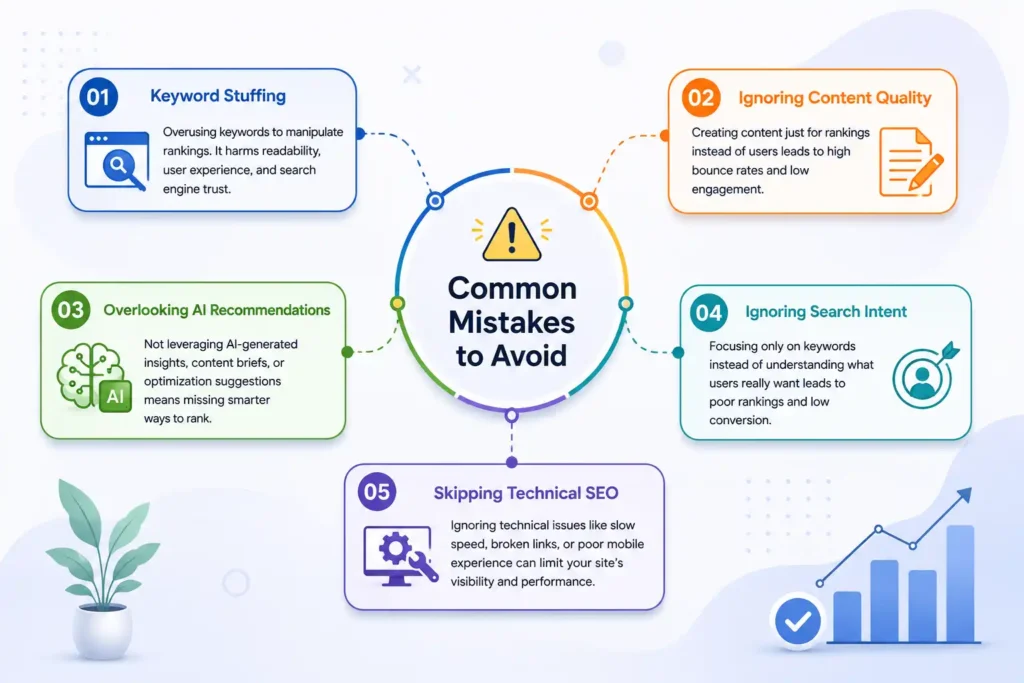
Copy-paste AI content published without any edits or added value tends to read as generic and rarely performs well, since search engines increasingly favor content that shows genuine expertise and originality.
No fact checking is a serious risk with AI-generated drafts, since language models can produce confident-sounding but inaccurate information that damages trust if it reaches your readers.
Ignoring search intent means writing content that technically covers a keyword but does not actually answer what the searcher wanted, which leads to poor engagement and high bounce rates.
Thin content that covers a topic superficially, even if it is well-optimized on paper, struggles to compete against comprehensive articles that fully satisfy a reader’s question.
Frequently Asked Questions
What is the best AI SEO tool?
There is no single best tool for everyone. Semrush is the strongest all-in-one option, Surfer SEO and Frase lead in content optimization, and NeuronWriter offers the best value for smaller budgets. The right choice depends on your specific workflow and budget.
Is ChatGPT good for SEO?
Yes, for brainstorming, drafting, and rewriting content, but it does not have built-in access to real-time SERP data or keyword volume, so it works best alongside a dedicated SEO tool rather than as a replacement for one.
Which AI SEO tool is free?
MarketMuse and NeuronWriter both offer functional free tiers with limited monthly queries, and ChatGPT has a free plan as well, though each comes with usage limits that most active content teams will eventually outgrow.
Can AI improve Google rankings?
AI tools can improve rankings indirectly by helping you research faster, cover topics more thoroughly, and match search intent more precisely. They do not guarantee rankings on their own, since real-world factors like backlinks, EEAT, and site authority still matter.
Are AI SEO tools worth it?
For most businesses publishing content regularly, yes. The time saved on research and optimization alone usually justifies the cost, especially for teams producing more than a few articles per month.
What is GEO?
GEO stands for Generative Engine Optimization, the practice of structuring content so it is more likely to be cited or referenced inside AI-generated answers from tools like ChatGPT, Gemini, and Google AI Overviews.
Do AI SEO tools work for local businesses?
Yes, tools like SE Ranking include local rank tracking and Google Business Profile integration, which are particularly useful for businesses trying to rank in a specific city or region.
How much do AI SEO tools typically cost?
Prices in 2026 range from free tiers up to roughly $150 to $200 per month for solid mid-tier plans, with enterprise pricing climbing well beyond that depending on team size and feature needs.
Can beginners use AI SEO tools without SEO experience?
Yes, most modern tools are built with guided workflows and clear scoring systems specifically so that beginners can follow along without needing deep technical SEO knowledge.
Should I use more than one AI SEO tool?
Many SEO professionals do, often pairing a research-heavy tool like Ahrefs or Semrush with a content optimization tool like Surfer SEO or NeuronWriter, since few single platforms cover both keyword research and content grading equally well.
Also Read : What’s the Future of Digital Marketing with AI Tools Like ChatGPT?
Final Thoughts
AI SEO tools have moved from a nice-to-have to a genuine competitive advantage in 2026. Search itself has changed, with AI Overviews and conversational AI search sitting alongside traditional Google results, and the tools built to handle both keyword research and AI visibility tracking are the ones worth paying attention to.
If budget is tight, NeuronWriter or Frase deliver strong optimization value without a large commitment. If you need a full-featured platform covering SEO, content, and AI search visibility together, Semrush and Ahrefs remain the most complete options. And if your priority is fast, writer-friendly content scoring, Surfer SEO and Clearscope are hard to beat.
Whichever tool you choose, remember that AI handles the research and the heavy lifting, but the strategy, the original insight, and the human judgment behind great content still come from you. Pick a tool that fits your budget and workflow, commit to editing every AI draft carefully, and focus on genuinely useful content, and better rankings tend to follow.
If you want expert help turning this kind of AI-powered SEO strategy into real results for your business, Global Digizone offers SEO, content writing, and full digital marketing services built for exactly this shift in how people search.
SEOwithRishi