
Introduction: AI and the New Era of Digital Marketing
Today, if you want to stay ahead in digital marketing, understanding and using artificial intelligence (AI) has become absolutely necessary. In the last few years, AI has completely changed the world of digital marketing. Whether it is writing content, running ads, or communicating with customers, AI is being used everywhere.
In 2026, AI in digital marketing is no longer just a trend, it has become a necessity. Businesses and marketers who adopt AI now move far ahead of their competitors. In this blog, we will explain step-by-step how AI is used in digital marketing, which are the best AI tools available, and how you can use it for your business.
Global Digizone, one of the most trusted digital marketing institutes in Indore, regularly teaches students AI-powered marketing strategies because AI knowledge has now become a must in the industry. So let’s get started.
What is AI in Digital Marketing?
Artificial Intelligence (AI) is a technology that enables machines to think, learn, and make decisions like humans. When we talk about AI in digital marketing, we are talking about all those tools and technologies that automatically analyze data, identify patterns, and help in making marketing decisions.
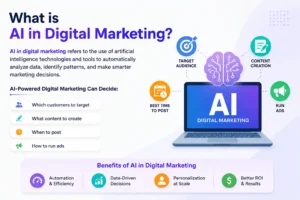
In simple words, AI-powered digital marketing is a process where computers and software automatically decide:
- which customers to target
- what content to create
- when to post
- how to run ads
This happens without you manually doing everything.
AI for digital marketers means bringing together automation, personalization, and intelligence. This technology is no longer limited to big companies. Small businesses and startups can also afford AI tools and use them to improve their marketing.
Some alternative terms you should know:
- Machine learning in marketing
- AI-powered marketing
- Intelligent marketing automation
- Predictive marketing analytics
- Automated digital marketing
- Data-driven marketing with AI
Why AI Matters in Digital Marketing in 2026
Data Has Increased Rapidly
Today, billions of people use social media, search on Google, and shop online every single day. This creates a huge amount of data. It is not possible for humans to analyze all this data manually.
AI can process this data in seconds and generate meaningful insights that directly improve your marketing strategy.
Customer Expectations Have Increased
Today’s customers expect personalized experiences. They want ads, emails, and content that match their interests.
AI makes this possible by analyzing each user’s behavior, preferences, and past actions. Generic marketing no longer works.
Competition is Very High
Competition in the digital space is growing every day. If you are not using AI, your competitors definitely are.
Machine learning in marketing is no longer a luxury; it has become a survival tool. Businesses that use AI get better results even with lower budgets.
Cost and Time Savings
Through AI marketing automation, businesses save a lot of time and money. Tasks that earlier required a full team and hours of work can now be done in minutes using AI tools.
Key Areas Where AI is Used in Digital Marketing
1. AI for Content Creation and Marketing
The use of AI in content marketing is growing very fast. AI-powered content creation tools like ChatGPT, Jasper AI, and Copy.ai now help marketers create blogs, social media posts, email copy, product descriptions, and ad copies.
This does not mean AI will replace human writers. Instead, AI enhances human creativity. You give a topic, AI creates a rough draft, and then you edit and finalize it.
This makes content production 3x to 5x faster, and you can publish more content consistently.
- Blog writing and article creation
- Social media captions and hashtag suggestions
- Email subject lines and body copy
- Product descriptions for e-commerce
- Ad copy for Google Ads and Facebook Ads
- Video scripts and podcast outlines
2. AI in SEO (Search Engine Optimization)
The combination of AI and SEO has become a game-changer in 2026. Google itself uses AI algorithms like RankBrain and BERT to determine search results. This means your SEO strategy should also be AI-aware.
AI-powered SEO tools like Surfer SEO, SEMrush AI, and Clearscope help you:
- find relevant keywords that people actually search for
- identify content gaps where you have not created content yet
- analyze competitors to see what they are doing
- optimize on-page SEO including headings, meta tags, word count, and internal linking
- prepare content for voice search optimization
The biggest benefit of artificial intelligence in SEO is that it helps you make data-driven decisions instead of relying on guesswork. You create content that people are actually searching for.
3. AI in Social Media Marketing
AI now plays a very big role in social media marketing. AI tools help you:
- find the best time to post when your audience is most active
- segment your audience so you can create different content for different groups
- do sentiment analysis to understand what people think about your brand
- automate content scheduling and posting
- identify the right influencers for your brand
- predict performance before publishing a post
Detailed use cases:
- Automatically identify the best time to post
- Audience segmentation for better targeting
- Sentiment analysis across platforms
- Automated scheduling and posting
- Influencer identification and outreach
- Performance prediction before publishing
4. AI in Email Marketing
Email marketing is still one of the most effective channels in digital marketing, and AI has made it even more powerful.
AI-powered email marketing helps you:
- generate personalized email content for each subscriber automatically
- optimize send time by deciding when each user should receive emails
- improve subject lines using automatic A/B testing
- predict churn and identify which users may unsubscribe
- give product recommendations based on past behavior
Detailed use cases:
- Personalized email content for each subscriber
- Automated send time optimization
- AI-powered subject line A/B testing
- Churn prediction before it happens
- Product recommendations in emails
5. AI in Paid Advertising (PPC)
AI is now a default part of platforms like Google Ads and Facebook Ads. Features like Smart Bidding, Performance Max campaigns, and Advantage+ campaigns are all AI-driven.
AI automatically decides:
- which ad should be shown to which user
- when and where the ad should be shown
- how much to bid and adjust bids automatically for better ROI
- which ad creative will perform the best
Using AI in paid marketing campaigns gives much better results compared to manual optimization because AI can analyze thousands of data points at once, which is not possible for humans.
6. AI Chatbots and Customer Service
AI chatbots have become an important part of modern digital marketing strategies. They can handle customer queries 24/7 without any human agent.
AI chatbots can:
- provide instant customer support without human intervention
- qualify leads by identifying interested customers
- recommend products to help customers find the right option
- handle order tracking and FAQs
- communicate in multiple languages
Detailed use cases:
- 24/7 instant customer support
- Lead qualification automatically
- Product recommendations based on behavior
- Order tracking and FAQ handling
- Multi-language support
7. AI in Analytics and Data Insights
Another important use of intelligent marketing automation is in analytics. Traditional analytics tools tell you what happened, but AI-powered analytics tells you why it happened and what will happen next. This is called predictive analytics.
AI helps in:
- predicting customer behavior (who is likely to buy)
- predicting churn (which customers may leave)
- revenue forecasting (expected revenue in the next month)
- campaign performance prediction (which strategy will give better results)
Detailed use cases:
- Customer behavior prediction
- Churn prediction
- Revenue forecasting
- Campaign performance prediction
Also Read : Digital Marketing Course After 12th in Indore
Comparison: Traditional vs AI-Powered Digital Marketing
| Aspect | Traditional Marketing | AI-Powered Marketing |
| Content Creation | Manually written | AI drafts, human edits, 5x faster |
| Audience Targeting | Broad demographics | Hyper-personalized targeting |
| Data Analysis | Manual Excel reports | Real-time automated insights |
| Ad Optimization | Manual A/B testing | Automated continuous optimization |
| Customer Support | Human agents, limited hours | AI chatbots, 24/7 available |
| Email Campaigns | Same email for everyone | Personalized per subscriber |
| SEO Research | Manual keyword research | AI-suggested keywords and gaps |
| Social Media | Manual scheduling and posting | AI-optimized timing and content |
| Cost Efficiency | Higher manpower cost | Lower cost per result |
| Decision Making | Gut feeling + limited data | Data-driven + predictive AI |
| Scalability | Limited by team size | Scales without extra headcount |
| Reporting | Weekly/monthly reports | Real-time automated dashboards |
Best AI Tools for Digital Marketing in 2026
Content Creation Tools
ChatGPT by OpenAI — Blog writing, ideation, copywriting, brainstorming
Jasper AI — Marketing-specific content, ad copy, email writing
Copy.ai — Short-form content, social captions, product descriptions
Writesonic — SEO-friendly articles and landing pages
Canva AI — Visual content creation with AI image generation
SEO Tools with AI
Surfer SEO — Content optimization and keyword clustering
SEMrush AI — Competitor analysis, keyword research, site audit
Ahrefs — Backlink analysis and content gap identification
Clearscope — Content grading and optimization
RankIQ — AI keyword research for bloggers
Social Media AI Tools
Hootsuite Insights — Social listening and sentiment analysis
Buffer AI Assistant — Post suggestions and performance insights
Predis.ai — AI-generated social media posts and videos
Email Marketing AI Tools
Mailchimp Smart Recommendations — AI-driven send time and product recommendations
HubSpot AI — Personalized email automation
ActiveCampaign — Predictive sending and lead scoring
Klaviyo — E-commerce-focused AI email personalization
Analytics and Ads AI Tools
Google Analytics 4 — AI-powered insights and audience prediction
Meta Advantage+ — Automated Facebook and Instagram ad targeting
Google Performance Max — All-in-one AI ad campaign management
How to Get Started with AI in Digital Marketing | Step by Step
Step 1: Understand Your Current Marketing Process
First, identify which marketing tasks you are currently doing that are time-consuming or where mistakes happen. These are the areas where AI can help the most. Make a simple list and arrange them based on priority.
Step 2: Start with One Simple AI Tool
In the beginning, do not try to implement everything at once. Start with one tool like ChatGPT. Use it for content ideas, blog outlines, and social media captions. Once you feel comfortable, gradually add more tools.
Step 3: Collect and Analyze Data
AI works best when it has data. Set up Google Analytics 4, install Facebook Pixel, and start collecting data about customer behavior. This data will be useful for future AI personalization.
Step 4: Integrate AI Tools into Your Workflow
Enable AI features in your existing tools like email platforms or social media schedulers. Test them and see which settings give the best results for your business. Set automation rules so that tasks run automatically.
Step 5: Test, Learn, and Improve
Success with AI marketing does not happen instantly. You need to continuously run A/B tests, analyze results, and improve your strategy. Review your results every month and make adjustments accordingly.
Also Read : Google Certified Digital Marketing Course in Indore 2026
Challenges of Using AI in Digital Marketing
AI has many benefits, but there are also some challenges that marketers face. It is important to understand them so you can adopt AI with realistic expectations.
- Data privacy concerns — AI needs a lot of data, but you must follow laws like GDPR and India’s DPDP Act
- High initial learning curve — It takes time to learn new AI tools, especially for beginners
- Over-dependence on AI — Relying too much on AI can reduce your brand’s authentic voice
- AI content can lack human touch — Sometimes AI-generated content may miss emotions and relatability, so editing is important
- Cost of premium tools — Some advanced AI tools can be expensive for small businesses
The solution is to use AI as an assistant, not a replacement. Combine human creativity and judgment with AI’s efficiency and data analysis power for the best results.
Future of AI in Digital Marketing
Even after 2026, the role of AI in digital marketing will continue to grow. Some important upcoming trends you should know:
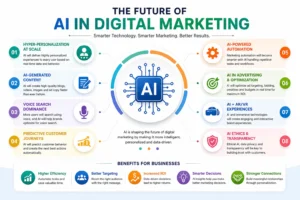
- Hyper-personalization at scale — Completely unique experiences for every user automatically
- AI-generated video content — Creating professional videos directly from text
- Voice search dominance — Content optimized for voice assistants
- Predictive customer journeys — AI predicting what a customer will buy before they do
- Augmented Reality marketing — AI-powered AR experiences where customers can try products virtually
- AI ethics and transparency — Brands will need to clearly inform users where AI is being used
Marketers who start preparing for these trends today will stay ahead in the future digital marketing landscape.
Conclusion
AI in digital marketing is no longer an option, it is a necessity. Businesses and marketers who adopt AI now will move far ahead of their competitors.
Whether you are creating content, improving SEO, managing social media, or optimizing paid ads, AI can help in every area.
The most important thing is to use AI not as a replacement, but as a powerful assistant. Combine human creativity and judgment with AI’s efficiency and data analysis capabilities. That is the most effective approach for long-term success.
If you want to build a career in digital marketing or grow your business, start learning and using AI tools today. And if you want proper guidance, Global Digizone offers courses that provide a strong foundation with practical AI marketing training included.
Frequently Asked Questions
Q1. What is AI in digital marketing?
AI in digital marketing means using artificial intelligence technology to automate, personalize, and optimize marketing tasks. It includes content creation, SEO, email marketing, social media, and paid advertising. It helps marketers make better decisions and get faster results.
Q2. Will AI replace digital marketers?
No. AI is a tool that makes marketers more efficient. It automates routine tasks so marketers can focus on creative and strategic work. Those who learn AI will be in higher demand, not less.
Q3. How much budget is needed to use AI tools?
Many AI tools offer free plans like ChatGPT free tier, Google Analytics, and Canva free version. You can start without spending money. As your business grows, you can invest in premium tools.
Q4. Can beginners learn AI in digital marketing?
Yes. AI tools are designed to be easy to use. If you understand basic digital marketing, learning AI tools is not difficult. At Globaldigizone, beginners are also taught AI marketing practically through real projects.
Q5. Which is the best AI tool for digital marketing in 2026?
It depends on your needs. For content, ChatGPT or Jasper; for SEO, SEMrush or Surfer SEO; for social media, Hootsuite; and for email marketing, Mailchimp or HubSpot are some of the best options. Start with one and expand gradually.
