Introduction: The Day Everything Changed
I remember talking to a small business owner last year. She was running an online clothing store, spending hours every week manually sending emails to her list of 4,000 subscribers. Same email. Same time. Same message for everyone.
Her open rate was 11%. Her click rate was barely 1.2%. She was exhausted and frustrated.
Three months after switching to AI automation in email marketing, her open rate hit 34%. Her revenue from email alone went up by 38%. And she was spending less than 2 hours a week on email instead of 10.
That story is not unique. It is happening to businesses all over the world right now.
This is not a guide full of theory and buzzwords. This is a practical, honest breakdown of what AI automation in email marketing actually is, how it works in the real world, and exactly how you can use it to grow your business in 2026 even if you are starting from scratch.
Let’s get into it.
What Is AI Automation in Email Marketing?
Here is the simplest way to understand it.
Traditional email marketing is like a megaphone. You write one message and blast it to everyone on your list at the same time. Some people respond. Most do not.
AI automation in email marketing is like having a personal assistant who knows every single subscriber on your list, their preferences, their habits, what they clicked last Tuesday, what they almost bought but did not and sends each of them a message tailored specifically to them, at the exact moment they are most likely to read it.
That is not an exaggeration. That is literally what technology does today.
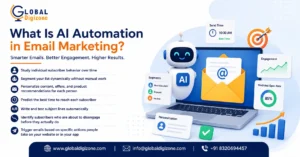
At its core, AI automation in email marketing uses machine learning algorithms to:
- Study individual subscriber behavior over time
- Segment your list dynamically without manual work
- Personalize content, offers, and product recommendations for each person
- Predict the best time to reach each subscriber
- Write and test subject lines automatically
- Identify subscribers who are about to disengage before they actually do
- Trigger emails based on specific actions people take on your website or in your app
The biggest shift here is the move from rule-based automation (if someone signs up, send this email after 2 days) to intelligent automation (if someone has visited this product page three times, has not bought yet, and typically opens emails at 7pm send them this specific offer tonight at 6:45pm).
That is the difference. And it is massive.
Why 2026 Is the Year You Cannot Ignore This
Let me give you some real context.
The average person receives over 121 emails per day according to data from Radicati Group. Inboxes have never been more crowded. At the same time, third-party cookies are largely gone, paid ads have become more expensive, and social media reach continues to decline for brands.
Email is the one channel where you own the relationship. Your list belongs to you — not to an algorithm, not to a platform that can change its rules tomorrow.
But owning a list is not enough. You need to use it intelligently.
Here is what is happening in the market right now:
Consumers expect relevance. According to McKinsey research, 71% of consumers expect personalized interactions from brands. When they do not get it, 76% get frustrated. Frustration leads to unsubscribes.
AI adoption is accelerating fast. HubSpot’s 2025 marketing report found that companies using AI in their email marketing saw 41% higher revenue per email than those using traditional methods.
The gap between AI users and non-users is widening. Brands that adopted AI automation in email marketing early are building compounding advantages: better data, smarter models, higher returns. The longer you wait, the harder it gets to catch up.
Email still dominates ROI. Litmus research consistently shows email delivering around $36–$42 return for every $1 spent. With AI, that ceiling gets pushed even higher.
The honest truth is this: if you are not using AI automation in email marketing in 2026, you are not just missing an opportunity. You are actively giving ground to competitors who are.
Read Also : How AI is Changing the Future of Digital Marketing in 2026
How AI Personalization Works | The Real Story
Let me walk you through something that actually happened.
A mid-sized skincare brand was sending weekly newsletters to 25,000 subscribers. Everyone got the same email same products, same discount, same copy. Their revenue from email was flat for eight months straight.
They switched to an AI-powered platform and turned on dynamic personalization. Now, a subscriber who had browsed anti-aging products three times got an email featuring those exact products with a specific testimonial from someone their age. A subscriber who had only ever bought cleansers got a completely different email focused on skincare routines.
Same send. Completely different experience for each person.
Revenue from email jumped 52% in the next quarter.
Here is how AI personalization actually works technically:
Every time a subscriber interacts with your emails or your website, that data gets collected and fed into a machine learning model. The model builds what is called a behavioral profile for each subscriber.
That profile includes:
- Which products or pages they visited and how many times
- What they purchased and when
- What kind of subject lines they open (urgency vs. curiosity vs. value-based)
- What time of day they engage with emails
- How long they have been on your list
- Whether their engagement is increasing or decreasing
- What category of content they click on most
Right before an email sends, the AI engine queries this profile and populates your email template with the most relevant content for that specific person. It pulls product recommendations from your catalog, selects the right image, adjusts the offer, and even tweaks the copy tone all automatically.
What AI personalizes in 2026:
Subject lines and preview text — Not just the name. The entire emotional angle of the subject line changes based on what each subscriber has responded to historically.
Hero images — A fitness brand can show running gear to one subscriber and yoga equipment to another — inside the same campaign template.
Product and content recommendations — AI-powered recommendation engines analyze purchase history, browsing behavior, and similarity to other customers to surface the products most likely to convert.
Offer type — Some subscribers respond to percentage discounts. Others respond to free shipping. Others respond to urgency (“only 3 left”). AI learns which lever works for whom.
Email length and tone — Power users who engage deeply with content get detailed emails. Casual browsers get short, punchy emails with one clear CTA.
Send frequency — Active subscribers might receive emails more often. Disengaged ones receive fewer to prevent unsubscribes and protect your sender reputation.
This level of personalization was only available to large enterprise brands with massive tech teams five years ago. Today, platforms like Klaviyo, HubSpot, and ActiveCampaign make it accessible to businesses of every size.
Smart Segmentation: Stop Guessing Who Your Customers Are
Old segmentation was better than nothing. You split your list by gender, age, or location and called it a day. The problem was that it was mostly guesswork dressed up as strategy.
AI segmentation is something entirely different.
Instead of you deciding how to group your subscribers, the AI analyzes behavioral patterns and creates segments you might never have thought of and it updates those segments automatically as behavior changes.
The segmentation models that matter most in 2026:
RFM Analysis (Recency, Frequency, Monetary Value) This is one of the most powerful e-commerce segmentation frameworks available. AI automatically identifies:
- Who bought recently
- Who buys most often
- Who spends the most
Combine those three dimensions and you get a clear picture of your best customers, your at-risk customers, and your lapsed customers — without building a single manual filter.
Lifecycle Stage Segmentation AI places every subscriber into a stage that reflects where they are in their relationship with your brand:
- Brand new subscriber (first 7 days)
- Engaged browser (visiting but not buying)
- First-time buyer
- Repeat customer
- VIP (top 10% by value)
- At-risk (engagement dropping)
- Lapsed (no activity in 90+ days)
Each stage gets a different email experience. Someone who just signed up needs a warm welcome and education. A VIP customer needs exclusive early access and rewards. A lapsed subscriber needs a strong re-engagement reason.
Predictive Segments This is where it gets genuinely exciting. AI can tell you right now which subscribers on your list are most likely to make a purchase in the next 7 days. You can build a campaign specifically targeting those people with your best offer.
It can also identify who is most likely to churn in the next 30 days so you can send a re-engagement campaign before they disappear.
The key advantage of AI segmentation over manual segmentation is that it never goes stale. As subscribers behave differently, they move between segments automatically. You do not have to rebuild your lists every month. The system handles it.
Also Read : AI vs Human Content Writing | Which is Better for SEO in 2026?
Subject Line Optimization with AI
Think about the last email in your inbox that you opened without hesitation. What made you click?
Something in that subject line triggered you curiosity, urgency, relevance, a specific number, a question. It felt personal. It felt timely. It was not an accident.
AI has cracked the code on subject lines in a way that human intuition simply cannot match at scale.
Here is what an AI subject line tool actually does:
It analyzes your entire campaign history every subject line you have ever sent, every open rate, every click-through. It identifies patterns that correlate with high performance for your specific audience. It generates dozens of variants based on different psychological triggers. Then it scores each one and recommends the top performers.
During a live campaign, it can test multiple variants in the first hour of sending, identify the winner, and automatically shift the rest of your send to the winning version. You capture the most opens possible from a single campaign.
What the data consistently shows:
According to Campaign Monitor, personalized subject lines generate 26% higher open rates on average. Subject lines with numbers (like “7 ways to…” or “Increase your open rate by 34%”) consistently outperform generic statements. Questions create engagement — they trigger a natural human desire to find out the answer. On mobile devices, subject lines between 30 and 50 characters perform best because they display fully without being cut off.
Emojis work — but only when they feel natural and match your brand voice. A single relevant emoji at the beginning or end of a subject line can lift open rates by 5–10% in the right context.
Tools that do this well include Phrasee, the built-in AI subject line tools in Klaviyo and HubSpot, and Copy.ai’s email marketing features.
Send-Time Optimization Why Timing Changes Everything
Here is a mistake nearly every marketer makes at some point.
They read an article that says “Tuesday at 10am is the best time to send emails.” They schedule every campaign for Tuesday at 10am. Results are mediocre. They read another article that says “Thursday evening is best.” They switch. Results are still mediocre.
The problem is not the research. The problem is that there is no universal best time for email. The best time depends on each individual subscriber.
The retired person living in a quiet suburb checks their inbox at 8am with their morning coffee. The busy working parent barely looks at personal email until 9pm when the kids are in bed. The college student is most active between 11pm and 1am.
Your list has all of these people in it. Sending everyone’s email at the same time means most of them are getting it at the wrong moment.
AI solves this with per-subscriber Send-Time Optimization (STO).
Machine learning models analyze each subscriber’s historical engagement data — specifically looking at when they have opened and clicked your emails in the past — and build a prediction for when each individual is most likely to engage.
Instead of sending one big blast at 10am on Tuesday, your campaign goes out over a 24-hour window. Each subscriber receives the email within their personal optimal window.
Real results from STO:
Klaviyo’s internal data shows that campaigns using send-time optimization see an average 20 to 35% improvement in open rates. ActiveCampaign reports similar numbers. Click-through rates improve by 15 to 25% on average. Unsubscribe rates drop because people receive emails at natural moments rather than intrusive ones.
If your current platform supports send-time optimization and most major platforms now do turning it on is one of the quickest, easiest wins available in AI automation in email marketing. It requires no extra copy, no new design, no strategy change. Just a setting you enable once.
Predictive Analytics: Knowing What Your Subscribers Will Do Before They Do It
This is the part of AI automation in email marketing that genuinely feels like a superpower once you start using it.
Traditional email marketing is reactive. You send a campaign, look at who opened it, see who bought, and decide what to do next based on what already happened.
Predictive analytics flips the entire model. Instead of reacting to the past, you anticipate the future.
Here is a real-world example:
An online furniture retailer using predictive analytics noticed that a specific segment of subscribers had been browsing living room sets repeatedly over a two-week period. Their AI model flagged these subscribers as high purchase intent — statistically likely to buy within the next 10 days.
The marketing team triggered a targeted campaign to exactly this segment with a limited-time free delivery offer. The conversion rate on that campaign was 11.4% compared to their average email conversion rate of 2.1%.
They did not create new products. They did not change their pricing. They just got the right message to the right people at the right moment because predictive analytics told them who those people were.
What predictive analytics does in practice:
Next purchase prediction — AI identifies which subscribers are entering their natural purchase window based on historical buying patterns. Perfect for triggered campaigns and upsells.
Churn risk scoring — Every subscriber gets a churn risk score. The model flags people whose engagement is dropping before they actually unsubscribe. You can run proactive win-back campaigns when there is still something to save.
Product affinity modeling — AI maps which categories, brands, or product types each subscriber gravitates toward. Recommendations become dramatically more accurate — and more profitable.
Customer lifetime value forecasting — Not all subscribers are equal. AI tells you which ones have the highest long-term revenue potential so you can prioritize them with better offers, exclusive access, and loyalty programs.
Optimal offer prediction — Over time, AI learns whether a specific subscriber responds better to a 20% discount, free shipping, a gift with purchase, or urgency-based messaging. Your offers become personalized not just in content but in type.
The more data your AI model collects, the smarter it gets. Month three is better than month one. Month twelve is dramatically better than month three. It is a compounding advantage that builds over time.
Also Read : How to Use ChatGPT for Social Media Marketing in 2026
Top AI Email Marketing Tools in 2026 | Honest Comparison
There are dozens of email marketing platforms claiming to use AI. Not all of them are equal. Here is an honest breakdown of the best ones based on actual capabilities and real use cases:
Klaviyo — Best for e-commerce brands
Klaviyo has invested heavily in predictive analytics, smart segmentation, and send-time optimization. If you run an online store, this is likely your best option. Its integration with Shopify and WooCommerce is seamless, and its AI features are genuinely powerful rather than surface-level marketing claims.
HubSpot — Best for B2B and service businesses
HubSpot’s AI content assistant, lead scoring, and workflow automation make it the strongest choice for B2B companies. The full CRM integration means your email marketing connects directly to your sales pipeline. More expensive, but the functionality justifies it for the right business.
ActiveCampaign — Best for growing SMBs
ActiveCampaign hits a strong middle ground — more sophisticated than Mailchimp, more affordable than HubSpot or Salesforce. Its automation builder is excellent and its predictive sending and machine learning features are reliable and well-implemented.
Mailchimp — Best for beginners
Mailchimp has added meaningful AI features in recent years — content optimizer, smart recommendations, send-time optimization. If you are just getting started and want a platform that is easy to learn with AI capabilities built in, Mailchimp is a solid entry point.
Brevo (formerly Sendinblue) — Best for budget-conscious teams
Brevo offers genuine AI send-time optimization, solid automation workflows, and good transactional email capabilities at a price point significantly lower than the competition. A strong option for lean teams that need capability without a big budget.
Salesforce Marketing Cloud — Best for enterprise
If you are running a large enterprise operation with complex data needs and multiple customer touchpoints, Salesforce Marketing Cloud with Einstein AI is the most powerful platform available. The implementation is complex and expensive, but the capabilities are unmatched.
Omnisend — Best for omnichannel e-commerce
Omnisend shines when you need to coordinate email with SMS, push notifications, and web popups. Its AI product picker and automation workflows are strong for e-commerce brands that want to run true omnichannel campaigns.
Moosend — Best value for growing teams
Moosend is underrated. It offers AI subject line tools, a solid automation builder, and a landing page creator at a price that makes it one of the best value platforms in the market. Growing teams that need real capability without enterprise pricing should look closely at Moosend.
Step-by-Step: Building Your First AI Email Workflow
Theory is great. Execution is what actually grows your business. Here is a practical framework for building your first AI-powered email workflow — starting today.
Step 1 — Choose one specific goal
Resist the temptation to build everything at once. Pick one objective: nurture new leads, recover abandoned carts, onboard new customers, or re-engage lapsed subscribers. One focused workflow done well beats five half-built ones.
Step 2 — Connect your data sources
Your AI is only as smart as the data it has access to. Connect your email platform to your CRM, your website analytics, your e-commerce store, and any other relevant data source. The more behavioral data flows in, the smarter your AI decisions become.
Step 3 — Set up your AI segments
Use your platform’s AI segmentation to create dynamic groups relevant to your goal. If you are building an abandoned cart sequence, create segments based on cart value, product category, and how many times the person has abandoned before. Let the AI auto-assign and auto-update these segments.
Step 4 — Write your email sequence
Create three to seven emails for your workflow. Write in a genuine human voice — not corporate marketing speak. Use dynamic content blocks inside each email so the AI can personalize elements per subscriber without you creating separate versions.
Step 5 — Enable AI features inside your platform
Turn on send-time optimization, subject line scoring, and predictive product recommendations. On most platforms this is a toggle or setting within the campaign builder. Take 10 minutes to enable these — the performance improvement is immediate.
Step 6 — Define your triggers
What action starts the workflow? A form submission. A product page visit. An abandoned cart. A first purchase. A period of inactivity. A specific link click. Define the trigger that matches your goal precisely.
Step 7 — Launch and shift to strategy mode
Go live. Check your metrics weekly — open rates, click rates, conversion rates, revenue per email. Let the AI run its tests. Your role shifts from tactical execution to strategic oversight. You review what is working, make high-level decisions, and build the next workflow when this one is running smoothly.
Mistakes That Are Silently Killing Your Campaigns
Even with the best AI tools, certain mistakes consistently destroy results. These are the ones worth watching closely.
Letting AI write everything without a human review
AI can generate email copy, subject lines, and product recommendations — but if you never review the output, you risk sending things that feel robotic, off-brand, or factually wrong. AI assists. You decide.
Ignoring list hygiene
Invalid email addresses, hard bounces, and chronically inactive subscribers damage your sender reputation. A damaged sender reputation means your emails go to spam — even the well-personalized, perfectly timed ones. Clean your list every 90 days.
No welcome sequence
The first seven days after someone subscribes are your highest-engagement window. These subscribers are warm. They just opted in. If you are not sending a thoughtful welcome sequence during this window, you are missing your best opportunity to build a relationship.
Mobile-first is not optional
According to Litmus, over 65% of emails are now opened on mobile devices. If your email design does not look great on a phone — if text is too small, buttons are too close together, images do not load correctly — you lose the subscriber regardless of how good your AI optimization is.
Overriding AI frequency recommendations
Sometimes marketers get excited and want to send more emails than the AI recommends. Sending too frequently causes fatigue, unsubscribes, and spam reports — all of which hurt your overall program performance. Trust the frequency data.
Weak or unclear calls to action
AI can get your email opened. It can put the right offer in front of the right person at the right time. But if your CTA is vague (“learn more” instead of “get your 20% discount now”), you lose the conversion at the finish line. Be specific. Be direct. Make it obvious what you want the reader to do.
Not updating your strategy
AI learns from your data. But your strategy still needs human oversight. Review your workflows every quarter. Check whether your segments still make sense. Update your email copy to reflect new products, new seasons, and new offers. AI optimizes execution — strategy still requires human thinking.
Also Read : Best AI Tools for Digital Marketing in 2026
Real ROI Numbers: What to Actually Expect
Let me be straightforward with you here.
AI does not transform results overnight. It is not a magic button. The brands that get the best results are the ones who set things up properly, give the AI enough data to learn from, and commit to running it for at least 60 to 90 days before drawing conclusions.
With that said, here is what properly implemented AI automation in email marketing actually delivers based on reported industry data:
Open rate improvement: 20 to 45% above baseline — primarily driven by send-time optimization and AI subject line testing
Click-through rate improvement: 15 to 30% above baseline — driven by better personalization and dynamic content
Revenue per email increase: 25 to 41% — driven by predictive product recommendations and intelligent segmentation
Time savings for marketing teams: 50 to 70% reduction in manual work — workflows that used to take 10 hours per week run in 2 to 3 hours
Unsubscribe rate reduction: 10 to 20% — because people are getting relevant emails at appropriate times instead of generic blasts at random moments
The compounding effect is real. Month one, you set things up and start collecting data. Month three, the AI models have enough to make strong predictions. Month six, you are operating with a level of intelligence and personalization that would have required a team of five people doing manual work just three years ago.
How Global Digi Zone Helps You Do This Right
At GlobalDigiZone, we work with businesses every day who are trying to figure out exactly what we have covered in this guide — and struggling to implement it on their own.

We have seen the full picture. The boutique e-commerce store owner spending 15 hours a week on email and getting 9% open rates. The B2B SaaS company with a list of 18,000 contacts and no automated nurture sequence. The growing brand that chose the wrong platform and wasted six months of data.
We have helped all of them — and hundreds of businesses like them — build AI-powered email marketing systems that actually perform.
Here is what working with GlobalDigiZone looks like:
We start with a free audit. We look at your current email setup — your platform, your list health, your automations, your metrics — and tell you honestly what is working and what is costing you revenue.
We recommend the right platform for your specific business. Not the most popular one. Not the one with the biggest marketing budget. The one that fits your model, your data, and your goals.
We build your AI workflows from scratch. Strategy, copywriting, segmentation, trigger logic, dynamic content — our team handles the full build so you do not have to figure it out alone.
We write email copy that sounds like you. Real human language. Your brand voice. Not template copy that reads like a robot wrote it.
We set up your tracking and reporting. You get clear visibility into what is working — open rates, click rates, revenue attribution, subscriber growth — without drowning in data you do not know how to use.
We optimize ongoing. Email marketing is not a set-it-and-forget-it channel. We review performance monthly, run tests, update sequences, and continuously improve results over time.
The businesses that partner with GlobalDigiZone for email marketing do not just see better metrics. They build a sustainable, owned marketing channel that keeps working whether they are in the office or on holiday.
Ready to find out what AI automation in email marketing can do for your specific business?
Visit globaldigizone.com today. Our team will do a free audit of your current email setup and give you a clear, honest picture of exactly where you are leaving revenue on the table — and how to fix it.
No pushy sales pitch. Just straight answers and a real plan.
The practical result is that AI automation gets smarter every month. In month one, it is making educated predictions. In month six, it has learned enough about your specific audience to make highly accurate decisions that a human marketer simply could not replicate manually at scale.
If you are currently running basic drip sequences and wondering why results are flat — this is likely the gap. Rules-based automation plateaus. AI automation compounds.
Also Read : How to Use AI in Digital Marketing in 2026
Final Thoughts
If there is one thing you take away from this guide, let it be this:
AI automation in email marketing is not about sending more emails. It is about making every single email you send more valuable — for your subscribers and for your business.
The technology has matured to the point where it is no longer complicated or expensive to implement. The platforms are accessible. The features are powerful. The results are measurable and real.
The business owner I mentioned at the beginning of this guide — the one who went from 11% open rates to 34% and grew her email revenue by 38%? She is not a tech person. She did not have a big budget. She just made the decision to stop doing email the old way and start doing it the smart way.
You can make that same decision today.
Start with one workflow. Pick the right platform. Connect your data. Let the AI learn your audience. Review the results in 90 days. Then build the next workflow.
That is the whole game. One smart campaign at a time, compounding over months and years into a marketing channel that generates revenue reliably — with less manual effort than anything else you are doing.
AI automation in email marketing is not the future anymore. It is the present. And the businesses building on it today are the ones who will be significantly ahead tomorrow.
FAQs
What is AI automation in email marketing?
AI automation in email marketing means using artificial intelligence to send the right email to the right person at the right time automatically. You do not have to manually write or send every email. The AI watches what your subscribers do, what they click, what they buy, when they open emails and sends personalized emails on its own. It gets smarter every month as it collects more data.
Is AI email marketing better than normal email marketing?
Yes, by a big margin. Normal email marketing sends the same email to everyone at the same time. AI email marketing sends different emails to different people based on their behavior, interests, and the best time for them personally. Businesses that switch to AI email marketing see 20% to 45% better open rates and up to 41% more revenue per email compared to traditional methods.
How much does AI email marketing cost?
It is more affordable than most people think. Here are real prices in 2026:
- Brevo — starts at $9/month
- Moosend — starts at $9/month
- Mailchimp — starts at $13/month
- ActiveCampaign — starts at $29/month
- Klaviyo — starts at $20/month
Even at $9 to $20 per month you get real AI features like send-time optimization, personalization, and smart segmentation. It is one of the cheapest and highest-return investments a small business can make.
Which is the best AI email marketing tool in 2026?
It depends on your business:
- Klaviyo — best for online stores
- HubSpot — best for B2B businesses
- ActiveCampaign — best for small and medium businesses
- Brevo — best for tight budgets
- Mailchimp — best for complete beginners
- Salesforce Marketing Cloud — best for large enterprises
Pick the one that matches your business type and budget — not just the most popular name.
How long does it take to see results from AI email marketing?
Here is an honest timeline:
- Month 1 — AI is learning your audience. Small improvements start showing.
- Month 2 — Open rates and click rates improve noticeably by 15% to 25%.
- Month 3 — Revenue per email starts increasing by 25% to 41%.
- Month 6 onwards — Everything compounds. Campaigns run automatically and keep improving.
Do not judge AI tools in week one. Give it 60 to 90 days and the results will speak for themselves.
SEOwithRishi