How to Rank Higher on Google Maps in India (2026 Guide)
If your business is not appearing in Google Maps results, you could be missing potential customers who are searching for your services nearby. Whether you run a clinic, restaurant, coaching institute, salon, repair service, or digital marketing agency, better local visibility can help customers discover and contact your business. Learning how to rank higher on Google Maps starts with optimizing your Google Business Profile, improving your website’s local SEO, collecting genuine customer reviews, and maintaining accurate business information. In this guide, Global DigiZone explains practical Google Maps SEO strategies that Indian businesses can follow in 2026.
What Is Google Maps Ranking and Why Does It Matter?
Google Maps ranking refers to the position your business occupies when people search for relevant products or services on Google Maps or through local search results. For example, when someone searches for “dentist near me” or “best taxi service in Indore,” Google may show a map with a list of relevant businesses.
Businesses that appear prominently in these results can receive more profile visits, phone calls, direction requests, website visits, and enquiries. However, a higher position does not guarantee more customers. Your services, pricing, reviews, website experience, and response to enquiries also influence whether people choose your business. Global DigiZone recommends focusing on useful business information and a good customer experience alongside local search visibility.
What Is the Google Maps Local Pack?
The Google Maps Local Pack is the group of local business listings that Google often displays near the top of search results for location-based searches. It typically highlights three businesses, although the layout can vary by search and device.
To improve your chances of appearing in local results, focus on these areas:
- Google Business Profile optimization: Keep your business information complete and accurate.
- Local relevance: Make it clear which services you provide and which locations you serve.
- Customer reviews: Encourage genuine reviews and respond professionally.
- Website SEO: Publish useful service and location information on your website.
- Business prominence: Build a trustworthy online presence through legitimate mentions, links, and customer feedback.
There is no guaranteed method to secure the first position on Google Maps. Rankings depend on several factors, including the searcher’s location and the specific search query. A consistent strategy, such as the one Global DigiZone recommends for local SEO, can help businesses build a stronger online presence over time.
How Does Google Determine Google Maps Rankings?
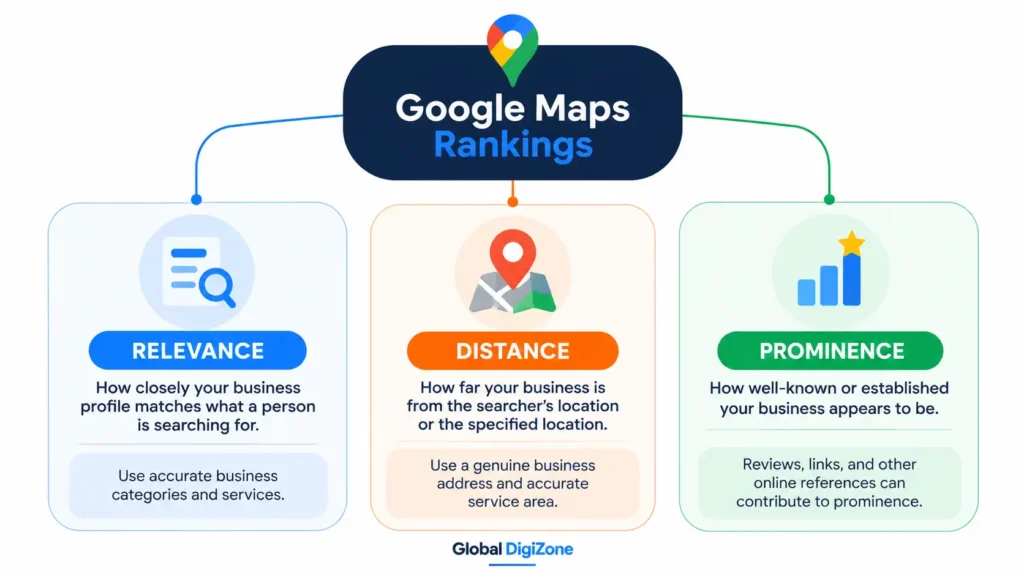
Google identifies three main factors for local results: relevance, distance, and prominence. Understanding these factors helps you plan your Google Maps SEO strategy more effectively. Global DigiZone considers these factors when identifying opportunities to improve a business’s local visibility.
Also read : Learn more about Google’s local ranking factors.
1. Relevance
Relevance measures how closely your business profile matches what a person is searching for. If someone searches for “physiotherapy clinic in Indore,” Google looks for businesses that offer relevant services and have accurate, useful profile information.
To improve relevance, select the most appropriate primary business category, add accurate secondary categories where applicable, list the services you actually provide, and maintain a complete business profile. Your website should also explain your main services clearly. Global DigiZone recommends using relevant business information instead of repeating keywords unnaturally.
2. Distance
Distance refers to how far a business is from the location specified in a search or the searcher’s location when no location is specified. A business located closer to the searcher may be more relevant for a nearby search, depending on the other factors.
You cannot control where a potential customer is located. You should use your genuine business address, accurately define your service area if you operate as a service-area business, and avoid creating fake locations to target additional areas. Global DigiZone recommends following Google’s business eligibility rules rather than creating misleading location listings.
3. Prominence
Prominence refers to how well-known or established a business appears to be. Google may consider information such as reviews, links, and other online references when assessing prominence.
You can work on prominence by earning genuine customer reviews, improving your website’s authority, maintaining consistent business information, and building meaningful local connections. Global DigiZone focuses on long-term trust and sustainable SEO practices rather than shortcuts that promise instant rankings.
How to Optimize Your Google Business Profile
Your Google Business Profile is one of the most important parts of a local SEO strategy. A complete and accurate profile helps potential customers understand your business and helps Google assess its relevance to searches. Global DigiZone recommends reviewing your profile regularly to ensure that customers can find accurate information about your services.
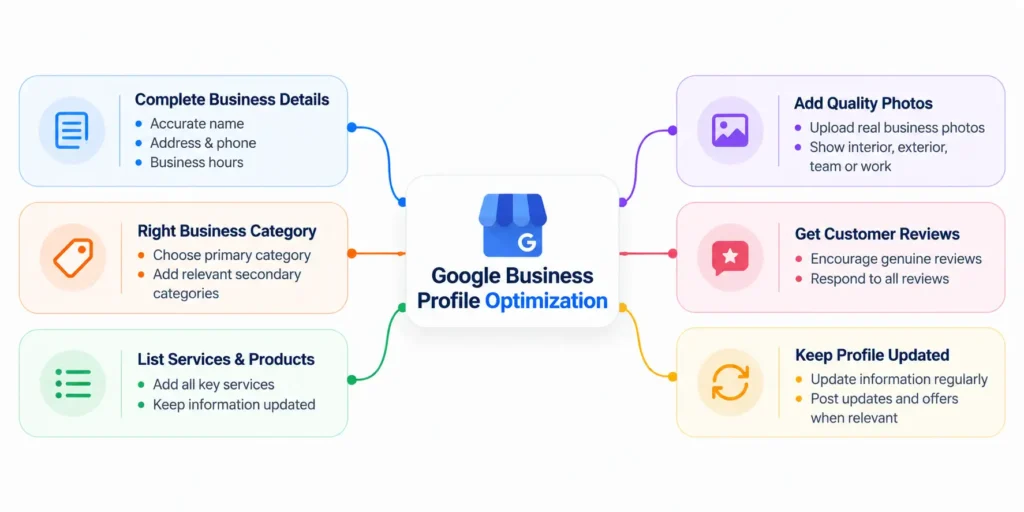
1. Complete Every Important Business Detail
Make sure your business profile includes accurate information about your business. Incomplete or outdated details can confuse customers and reduce trust.
Use this checklist when reviewing your profile:
- Business name that matches your real-world business name.
- Correct primary category and relevant secondary categories.
- Accurate business address, where applicable.
- Correct phone number and website URL.
- Updated business hours, including special holiday hours.
- Relevant services and service descriptions.
- Suitable business attributes, where available.
- A clear business description that explains what you offer.
Do not add extra keywords to your business name unless they are genuinely part of your real-world business name. Keyword stuffing in the business name can violate Google’s guidelines and put your profile at risk. Global DigiZone recommends keeping your business details accurate rather than adding keywords just to influence rankings.
2. Choose the Right Primary Business Category
Your primary category helps Google understand what your business mainly does. Choose the category that most accurately describes your core business rather than selecting a category simply because you believe it has higher search volume.
For example:
- A dental clinic should choose an appropriate dentist or dental clinic category.
- A taxi company should select the most relevant taxi or transportation category available.
- A digital marketing company should choose the category that best represents its main business activity.
- A restaurant should select the category that accurately describes its cuisine or restaurant type.
Add secondary categories only when they genuinely describe additional business activities. Avoid selecting unrelated categories to target more keywords. When planning Google Business Profile optimization, Global DigiZone recommends choosing categories based on actual business services and eligibility.
3. Add Relevant Services and Products
Use the services section to explain what customers can actually purchase or enquire about. A clinic may list its genuine treatments, a taxi company may describe airport transfers and outstation trips, and a marketing agency may list SEO, Google Ads, and social media marketing.
Keep service names clear and descriptions useful. Include relevant terms naturally, but do not repeat the same keyword unnecessarily. Your profile should help customers understand your offering rather than read like a list of search terms.
4. Upload High-Quality Business Photos
Photos help customers recognize your business and understand what to expect before visiting or contacting you. Use genuine, clear images instead of relying entirely on stock photos.
Consider uploading:
- Exterior photos that help customers identify the location.
- Interior photos showing the actual business environment.
- Team photos that introduce your staff.
- Genuine product or service photos.
- Relevant work samples, where appropriate.
- New photos when your premises, team, or services change.
Use clear image files and descriptive filenames before uploading them. However, do not expect image filenames alone to improve your ranking. Accurate profile information, relevance, and a strong overall online presence matter much more. Global DigiZone recommends prioritizing genuine business photos that help customers understand your services.
5. Keep Your Profile Active and Accurate
Review your profile regularly to ensure that customers see current information. Add updates when you have genuinely useful news, seasonal offers, new services, or important business announcements.
Follow this simple maintenance routine:
- Check business hours and contact information.
- Review services and categories when your offering changes.
- Publish relevant updates when there is something useful to share.
- Upload genuine new photos periodically.
- Check customer questions and respond where appropriate.
- Review Google notifications and profile changes.
Regular updates can improve the customer experience, but posting frequently does not guarantee higher Google Maps rankings. Global DigiZone recommends maintaining accurate information consistently instead of publishing updates only to increase posting frequency.
How to Get More Genuine Google Reviews
Customer reviews influence how potential customers perceive your business. They can help people compare local businesses and decide whom to contact. Reviews are an important part of your local presence, but they do not guarantee a specific ranking position. Global DigiZone recommends building a genuine review process that prioritizes customer experience and honest feedback.
1. Ask Satisfied Customers for Reviews
Make it easy for customers to leave honest feedback after they have used your product or service. You can share your Google review link through a follow-up message, email, invoice, or QR code at your premises.
For example, a local clinic can request feedback after an appointment, while a taxi business can share its review link after a completed trip. Keep the request polite and allow customers to express their genuine opinions.
2. Respond to Positive and Negative Reviews
Responding to reviews shows that you pay attention to customer feedback. Thank customers for positive reviews and address negative feedback calmly and professionally.
When responding to a negative review:
- Acknowledge the customer’s concern.
- Avoid arguments or personal comments.
- Explain how the issue can be addressed.
- Invite the customer to continue the discussion through an appropriate contact channel.
- Never disclose private customer information.
A thoughtful response can help rebuild trust, even when the original review is negative. Global DigiZone recommends treating reviews as an opportunity to understand customer concerns and improve service quality.
3. Avoid Fake Reviews and Incentives
Buying reviews, posting reviews for your own business through fake accounts, or offering rewards in exchange for reviews can violate Google’s policies. Do not ask employees or others to post misleading reviews either.
Build reviews through genuine customer experiences. Never pressure customers to leave only positive feedback, and do not offer discounts, gifts, or payments in exchange for reviews.
4. Make Review Collection a Consistent Process
Create a simple process so your team can request feedback naturally after a completed service. Monitor new reviews and respond regularly rather than waiting several months.
Remember that review quality, relevance, recency, and customer trust matter to your overall online reputation. Avoid obsessing over a particular number of reviews or trying to manipulate competitors’ ratings.
Also read : Read Google’s guidelines for customer reviews.
Use Local SEO to Improve Google Maps Visibility
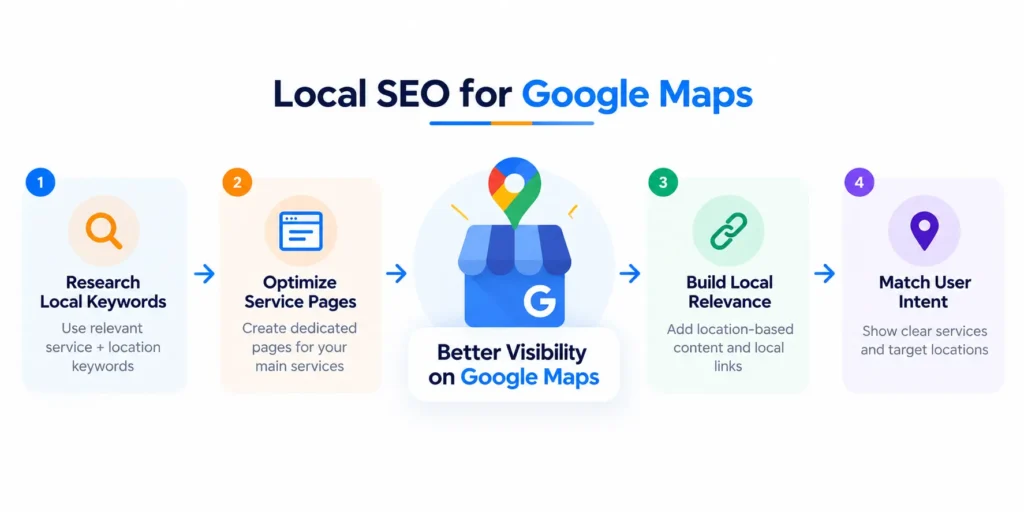
Google Maps optimization works best when supported by a website that clearly explains your services and business locations. Local SEO helps search engines and potential customers understand what your business offers and where it operates. Global DigiZone recommends combining Google Business Profile optimization with relevant website content and consistent business information to strengthen local visibility.
1. Research Local Keywords
Identify the search terms customers use when looking for your services. Focus on keywords that reflect real customer intent rather than selecting terms only because they appear popular.
Examples include:
- Dentist in Indore.
- Best taxi service in Indore.
- Digital marketing agency in Indore.
- Physiotherapy clinic near me.
- AC repair service in Vijay Nagar.
- Coaching institute in Satna.
Use keyword research tools, Google search suggestions, customer questions, and relevant search results to discover additional terms. Select keywords that match your actual services and target locations.
Add your primary keyword naturally to relevant website content. Avoid repeating city names or service keywords unnaturally across every heading and paragraph. Global DigiZone recommends focusing on search intent and relevant local terms rather than keyword stuffing.
2. Optimize Your Website’s Service Pages
Create clear website pages for your main services. Each page should explain what you offer, who the service is suitable for, how customers can contact you, and what makes your business trustworthy.
For example, a digital marketing agency may create separate pages for SEO services, Google Ads management, and social media marketing. A taxi company may create useful pages for airport transfers and outstation travel routes.
Your service pages should include:
- A clear page title and main heading.
- A concise explanation of the service.
- Relevant details about your service area.
- Useful information that answers customer questions.
- Genuine testimonials or examples, where appropriate.
- A visible phone number or enquiry option.
- Relevant internal links to related pages.
For businesses targeting Indore, a useful resource is Digital Marketing for Small Businesses in Indore. This resource from Global DigiZone provides further information about digital marketing for local businesses. Internal links should guide readers to genuinely relevant information rather than being added only to repeat keywords.
3. Keep Your Business Information Consistent
Your business name, address, and phone number should be accurate wherever your business is listed online. Inconsistent details can confuse customers and make it harder for them to identify the correct business.
Check your website, Google Business Profile, social media pages, and important business directories. Correct outdated phone numbers, old addresses, duplicate listings, and incorrect opening hours.
For businesses with multiple locations, provide accurate information for each genuine location. Do not create separate profiles for locations where your business does not actually operate or where it is not eligible to have a profile. Global DigiZone recommends keeping business details consistent across important online platforms.
4. Build Relevant Local Citations
A local citation is an online mention of your business information, such as its name, address, and phone number. Citations may appear in legitimate directories, industry websites, local business associations, and relevant community resources.
To build useful citations:
- Prioritize reputable directories relevant to your industry.
- Use consistent business details.
- Complete your listings accurately.
- Remove or correct duplicate and outdated entries where possible.
- Avoid low-quality directories created only to generate backlinks.
Citations can support business discovery and information consistency, but submitting your business to hundreds of directories does not guarantee improved Google Maps rankings. As part of a local SEO strategy, Global DigiZone recommends prioritizing quality and accuracy over the number of listings.
5. Earn Relevant Backlinks
Backlinks are links from other websites to your website. Relevant links can help people discover your business and may contribute to your website’s authority.
Consider earning links through local partnerships, professional associations, legitimate business directories, industry publications, community events, and useful content that other websites genuinely want to reference.
Avoid buying large quantities of low-quality links or participating in link schemes. Focus on relevant websites and meaningful relationships instead of chasing a high backlink count. Global DigiZone recommends building links through genuine relationships and useful content rather than relying on spammy tactics.
6. Add Appropriate Local Business Structured Data
Structured data is a format that helps search engines understand information on a website. Eligible businesses may use relevant LocalBusiness structured data to describe details such as their business name, address, telephone number, and opening hours.
Make sure structured data matches the visible information on your website. Use the appropriate schema type, test your implementation, and correct errors. Structured data can help search engines interpret your business details, but it does not guarantee a rich result or higher Google Maps position.
7. Improve Website Speed and Mobile Experience
Many local searches happen on mobile devices. If your website loads slowly, displays poorly on a phone, or makes it difficult to contact your business, visitors may leave before enquiring.
Improve your website experience by:
- Compressing large images.
- Removing unnecessary scripts and plugins.
- Using a reliable hosting service.
- Making phone numbers easy to tap.
- Keeping navigation simple.
- Ensuring forms work properly on mobile devices.
- Using secure HTTPS connections.
A fast, mobile-friendly website helps customers find information and contact your business more easily. It is an important part of the overall local SEO experience. Global DigiZone recommends checking mobile usability and website performance as part of regular SEO maintenance.
Also read : Explore Google’s LocalBusiness schema guidelines.
Google Maps SEO Tips for Different Businesses in India
The best local SEO strategy depends on the type of business you operate, your location, and how customers search for your services. Global DigiZone recommends tailoring local SEO work to the needs of each industry instead of applying the same strategy to every business.
For Clinics and Healthcare Businesses
Clinics should maintain accurate contact details, opening hours, appropriate business categories, and clear service information. Encourage genuine feedback from patients without exposing confidential information or pressuring anyone to leave a review.
Keep healthcare claims accurate and avoid making promises about guaranteed treatment outcomes. Use your website to explain services, practitioner qualifications, appointment options, and relevant patient information.
For Taxi and Travel Businesses
Taxi companies should make their service areas, contact details, business hours, and available transport services easy to understand. Explain genuine offerings such as airport transfers, local travel, and outstation trips where applicable.
Ensure that customers can easily call or enquire. Keep route and fare information accurate when you publish it, and request honest reviews from customers after completed journeys.
For Educational Institutes
Schools, colleges, and coaching institutes should maintain correct admission office details, location information, opening hours, and relevant educational categories. Keep the website updated with course information, admission requirements, campus details, and enquiry options.
Avoid publishing outdated admission announcements or misleading claims about placements, rankings, and results. Genuine and current information builds trust with students and parents.
For Shops, Salons, and Local Service Providers
Retail stores and salons can use accurate product or service information, real photos, business hours, and genuine customer feedback to strengthen their local presence. Service providers should clearly explain the areas they serve and avoid using an address that does not meet Google’s eligibility requirements.
For any business, the priority is to provide useful, consistent, and trustworthy information rather than trying to manipulate the ranking system.
Common Google Maps SEO Mistakes to Avoid
Some businesses struggle to improve local visibility because their profiles or websites contain inaccurate information, or they rely on shortcuts instead of building a trustworthy online presence. Global DigiZone recommends avoiding the following mistakes to protect your business profile and maintain a sustainable SEO strategy.
- Keyword stuffing: Do not add unnecessary keywords to your business name, description, or website content.
- Fake reviews: Never purchase reviews or create misleading feedback.
- Incorrect categories: Choose categories that genuinely represent your business.
- Wrong contact details: Keep your phone number, address, and operating hours accurate.
- Duplicate profiles: Check for duplicate listings and resolve them through the appropriate process.
- Fake locations: Do not create profiles at addresses where your business does not legitimately operate.
- Low-quality backlinks: Avoid link schemes and spammy directories.
- Outdated website pages: Update old service details, contact information, and location content.
- Ignoring reviews: Respond professionally to customer feedback.
- Expecting instant rankings: Local SEO requires consistent work, and results can vary by location and competition.
Following Google’s policies is essential for protecting your business profile. Avoid any SEO service that promises a guaranteed first position or claims it can control Google’s ranking decisions.
How to Track Your Google Maps SEO Performance
Google Maps SEO should be reviewed regularly so you can identify what is improving and which areas need attention. Use the performance information available in your Google Business Profile and compare it with website and enquiry data. Global DigiZone recommends measuring actual customer interactions alongside local search visibility.
1. Review Google Business Profile Performance
Depending on the data available for your profile, monitor:
- Searches that led people to your business profile.
- Profile views and other available engagement metrics.
- Calls initiated through the profile.
- Website clicks.
- Direction requests.
- Other customer interactions reported by Google.
Compare performance over consistent periods, such as month over month. Consider seasonality, changes in opening hours, promotions, and other factors before deciding whether a change is meaningful.
2. Monitor Local Search Rankings
Check how your business appears for important local search terms, such as your primary service and target location. Remember that Google Maps results can vary based on the searcher’s location, search wording, competition, and other factors.
Do not judge your entire SEO performance from one search on one phone. Use a consistent set of keywords and locations when reviewing visibility, and treat ranking checks as indicators rather than absolute measurements.
3. Check Website Traffic and Enquiries
Review website visits from organic search and the pages customers visit before contacting you. Also assess whether visitors are using your phone number, enquiry forms, or other contact options.
Look at business outcomes alongside rankings. More visibility is useful, but qualified calls, appointment requests, bookings, and genuine enquiries are often more meaningful than profile views alone. Global DigiZone recommends using these business outcomes to help decide which SEO improvements deserve attention next.
4. Maintain a Monthly SEO Checklist
Use this simple checklist to review progress every month:
- Check Google Business Profile information for accuracy.
- Review customer feedback and respond to new reviews.
- Update relevant service and website information.
- Check important local keywords and search visibility.
- Review calls, direction requests, website clicks, and enquiries.
- Correct outdated citations or duplicate information.
- Identify the pages and services that need improvement.
- Set priorities for the next month based on actual results.
Consistent monitoring helps you make informed decisions instead of changing your SEO strategy every time rankings fluctuate.
Also read : How to Learn Digital Marketing in 3 Months | A Complete Diploma Course Guide
How Global DigiZone Helps Businesses Improve Local SEO
Global DigiZone helps businesses strengthen their online presence through digital marketing and search engine optimization services. For businesses that want to improve local visibility, a structured strategy can bring together Google Business Profile optimization, website improvements, relevant content, and reputation management.
Our local SEO approach may include:
- Google Business Profile optimization: Improving profile completeness, categories, services, and business information.
- Local keyword research: Identifying relevant search terms based on your services and target locations.
- Website SEO: Improving service pages, internal linking, technical SEO, and mobile usability.
- Local citations: Reviewing business information across relevant directories and listings.
- Review management guidance: Helping businesses establish a genuine and professional feedback process.
- Performance reviews: Assessing available local search data and identifying opportunities for improvement.
The right strategy depends on your industry, location, competition, website condition, and current online presence. At Global DigiZone, the focus is on practical, customer-focused SEO strategies rather than unrealistic promises. No agency can honestly guarantee a specific Google Maps position, but consistent optimization can help build a stronger local search foundation.
If you want to understand our approach, read Global DigiZone’s Guide to Choosing an SEO Agency in Indore or explore our Digital Marketing Services in Indore.
Contact Global DigiZone
Global DigiZone – Digital Marketing and SEO Services
- Phone: +91 9074793901
- Alternate Phone: +91 7440880257
- Email: info@globaldigizone.com
- Address: Swadesh Bhawan, Press Complex, Near Dainik Bhaskar, Indore, Madhya Pradesh 452011
- Website: https://globaldigizone.com/
Contact Global DigiZone to discuss your website, local SEO requirements, and the most suitable strategy for your business.
Conclusion
Learning how to rank higher on Google Maps requires more than adding keywords to your Google Business Profile. Businesses should focus on accurate information, relevant categories, genuine customer reviews, useful website content, consistent local citations, and a reliable mobile experience. Regularly review your local search performance and make improvements based on real customer needs and available data.
Start by checking your Google Business Profile, correcting any inaccurate information, improving your main service pages, and creating a simple process for requesting genuine reviews. With consistent effort and a customer-focused local SEO strategy, your business can build stronger visibility and make it easier for nearby customers to find and contact you. For businesses looking for professional support, Global DigiZone offers digital marketing and SEO services designed to help improve their online presence.
Frequently Asked Questions (FAQs)
1. How can I rank higher on Google Maps?
Complete and maintain your Google Business Profile, select accurate categories, add relevant services, collect genuine customer reviews, and improve your website’s local SEO. Keep your business information accurate and follow Google’s policies.
2. How long does Google Maps SEO take to show results?
There is no fixed timeline. Results depend on competition, business location, profile quality, website condition, and existing online presence. Some improvements may become visible sooner than others, but local SEO generally requires ongoing effort.
3. Does Google Business Profile optimization improve rankings?
A complete and accurate profile can help Google understand your business and its relevance to local searches. However, profile optimization alone does not guarantee a higher position because distance, prominence, competition, and other factors also matter.
4. Do Google reviews help Google Maps rankings?
Reviews help potential customers assess a business and contribute to its online reputation. They are relevant to local SEO, but no specific number of reviews guarantees a particular ranking.
5. Can I rank on Google Maps without a website?
An eligible business can have a Google Business Profile without a website. However, a useful website can provide additional information about services, locations, and contact options and can support your overall online presence.
6. Can I rank my business in multiple cities on Google Maps?
Your business can appear in searches across different areas depending on relevance, distance, and prominence. However, you should not create fake locations to target multiple cities. Business profiles must meet Google’s eligibility rules, and service-area businesses should accurately represent the areas they serve.
7. Can an SEO agency guarantee the first position on Google Maps?
No agency can legitimately guarantee a specific Google Maps ranking. A professional agency such as Global DigiZone can help improve your profile, website, and local SEO strategy, but Google controls its search results and rankings can change.
SEOwithRishi